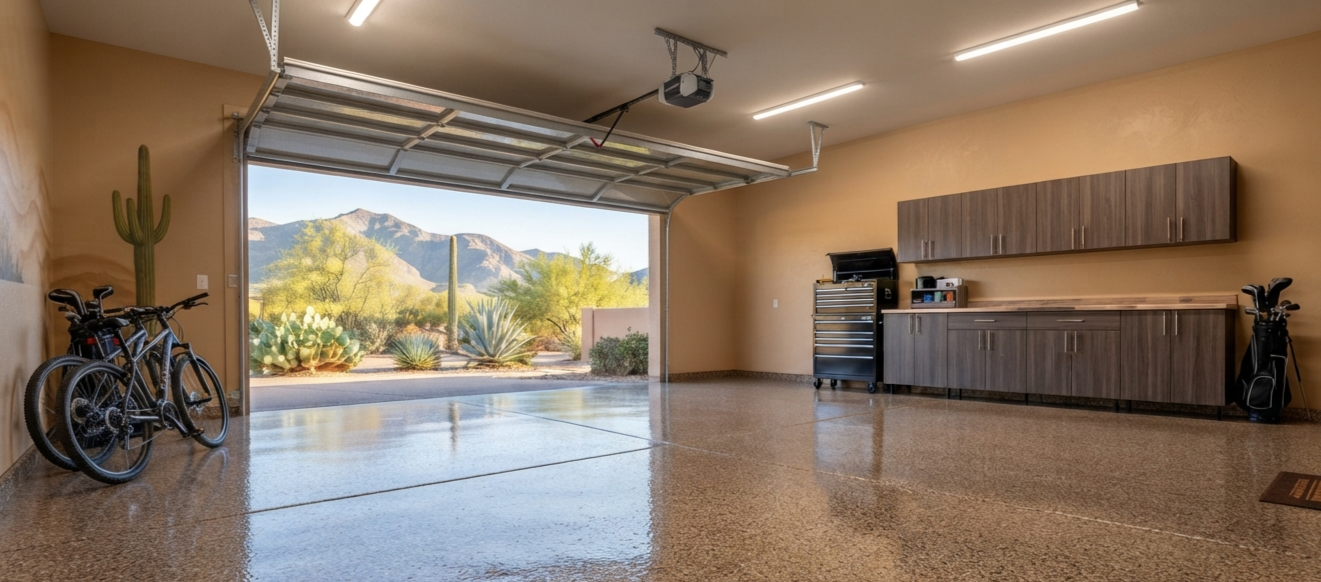
If you’ve started researching garage floor coatings, you’ve probably run into two names over and over: epoxy and polyaspartic. Both are legitimate, durable options — but they’re not interchangeable, and which one makes sense for your garage depends a lot on where you live. In a climate like Tucson’s, where garages regularly see triple-digit heat and direct sun for months at a time, the differences between the two matter more than they would in a milder market.
Here’s a straightforward, no-fluff comparison to help you figure out which system — or which combination of the two — is the right call for your floor.
Epoxy vs. Polyaspartic: Quick Comparison
| Factor | Epoxy | Polyaspartic |
| Cure time | 24–72 hours per coat; full cure can take up to a week | Often cures in hours; many systems are walkable the same day |
| UV resistance | Prone to yellowing and fading in direct sunlight over time | Excellent — formulated to resist UV breakdown |
| Durability | Very strong, especially as a base coat; can be prone to hot-tire pickup without a protective topcoat | Very strong; more resistant to hot-tire marks and temperature swings |
| Application window | More flexible with temperature and humidity | Can be trickier to apply in extreme heat due to fast cure time — timing matters |
| Cost | Generally lower cost per square foot | Typically higher cost per square foot |
| Best use case | Strong, affordable base layer; fine as a standalone system in shaded or low-sun garages | Ideal as a topcoat or standalone system in garages with heavy sun exposure |
If you only read one section of this article, that table is the fast answer. But the “why” behind it matters, especially if you want a floor that’s still holding up in five or ten years, not just on install day.
What Epoxy Does Well
Epoxy has been the standard for garage floor coatings for decades, and there’s a reason it’s stuck around: it’s strong, relatively affordable, and forms an excellent structural base layer. A properly applied epoxy coat bonds tightly to prepped concrete, resists most chemicals and stains, and stands up well to everyday foot and vehicle traffic.
Where epoxy runs into trouble is prolonged sun exposure. Standard epoxy resin isn’t naturally UV-stable, which means garages that get direct sunlight — through a window, an open door for extended periods, or a south- or west-facing entrance — can see the coating start to yellow, chalk, or fade over time. It’s not a structural failure exactly; the floor is often still intact and functional. But the finish that looked great on day one can look noticeably different a couple of summers later.
This is also where a lot of “epoxy floors don’t last” complaints actually come from. It’s less that epoxy is a bad product and more that a lot of installs use standard epoxy in a climate that demands more UV protection than the base material offers on its own.
What Polyaspartic Does Well
Polyaspartic coatings are a newer category — technically a type of polyurea — and they were developed partly to solve the exact problems epoxy struggles with in hot, sunny climates. Two things stand out.
First, cure time. Polyaspartic coatings cure dramatically faster than epoxy — often within hours instead of days. That means less downtime for your garage and, practically speaking, a shorter window during which dust, debris, or curious pets can mess up a wet floor.
Second, and more importantly for Tucson: UV stability. Polyaspartic resins are formulated to resist breakdown from ultraviolet light. That means a polyaspartic coating — or a polyaspartic topcoat over an epoxy base — is far less likely to yellow, chalk, or fade after a few Arizona summers. It also tends to hold up better against hot-tire pickup, which is the phenomenon where hot rubber tires slightly soften a coating and pull at it as the car moves, leaving marks or minor lifting over time. That’s a bigger issue in a place where asphalt-adjacent driveways and garage floors regularly bake at temperatures most coatings were never tested against.
The tradeoff is cost — polyaspartic systems typically run more per square foot — and the fast cure time cuts both ways. It’s a real benefit for scheduling, but it also means installers have a narrower window to work with the material correctly, especially in extreme heat. This is a case where installer experience matters as much as the product itself.
Why Many Pros Use Both
Here’s what often gets left out of the “epoxy vs. polyaspartic” conversation: in a lot of real-world installations, it’s not actually a choice between one or the other. A common and effective approach is layering both — an epoxy base coat for strength and adhesion, topped with a polyaspartic finish coat for UV resistance, faster cure time, and added durability against hot tires and everyday wear.
This combination plays to each material’s strengths. Epoxy is a proven, cost-effective structural layer. Polyaspartic protects that layer from the exact conditions — sun, heat, temperature swings — that cause standard epoxy to break down early in a desert climate. For a lot of Tucson garages, this hybrid system ends up being the most practical answer, rather than picking a side.
If you want a deeper look at why standard, non-UV-stable epoxy tends to struggle here specifically, we cover that in more detail in why standard epoxy fails in Arizona heat.
Which Should You Choose?
It comes down to your garage’s actual sun exposure, your budget, and how long you want the floor to look the way it did on day one.
- Low-sun garage, budget-conscious: A standard epoxy system is often perfectly adequate if your garage doesn’t get much direct sunlight and you’re not chasing a decade-plus showroom finish.
- High-sun garage (south- or west-facing doors, lots of natural light): A polyaspartic topcoat over an epoxy base is usually worth the extra cost. This is the situation where standard epoxy alone is most likely to disappoint you within a few years.
- Want the fastest turnaround: Polyaspartic’s rapid cure time makes it the better fit if you can’t have your garage out of commission for several days.
- Prioritizing long-term appearance over lowest upfront cost: The epoxy-plus-polyaspartic hybrid system tends to deliver the best combination of durability, UV stability, and value over the life of the floor.
Cost is obviously part of this decision too. For a detailed breakdown of what each system typically runs per square foot in Tucson, along with pricing by garage size, see our full epoxy flooring cost guide.
Get a Recommendation Specific to Your Garage
The right system really does depend on your garage’s layout, sun exposure, and how you use the space — which is hard to judge accurately from a blog post alone. If you’d like a straight answer for your specific situation, we offer free on-site assessments and can walk you through exactly which system (or combination) makes sense, with transparent pricing before any work begins.
Frequently Asked Questions
It depends on your priorities. Polyaspartic offers better UV stability and a much faster cure time, which makes it a strong choice for garages with heavy sun exposure. Epoxy is more budget-friendly and performs well as a base coat, especially in garages that don’t get much direct sunlight. Many professional installations use both together for the best overall result.
Polyaspartic is a type of polyurea coating. Compared to standard epoxy, polyurea-based coatings like polyaspartic generally cure faster and resist UV breakdown better, while standard epoxy is typically more affordable and serves as an excellent structural base layer.
In terms of surface appearance — resisting yellowing, fading, and hot-tire marks — polyaspartic coatings generally outperform standard epoxy under constant sun exposure. The underlying structural durability of both systems can be similar when properly installed, but polyaspartic’s UV resistance gives it a real edge specifically in hot, sunny climates like Tucson’s.
In many cases, yes — a polyaspartic topcoat can be applied over a properly prepped and adhered epoxy base, which is exactly the hybrid approach many installers recommend for Tucson garages. Whether it’s a good fit for your existing floor depends on its current condition, so it’s worth having it assessed first.
For garages with significant direct sun exposure, a polyaspartic topcoat over an epoxy base is typically the more durable long-term choice. For garages with limited sun exposure and a tighter budget, standard epoxy is often sufficient. A free on-site assessment is the most reliable way to know which fits your specific space.
Leave a Reply