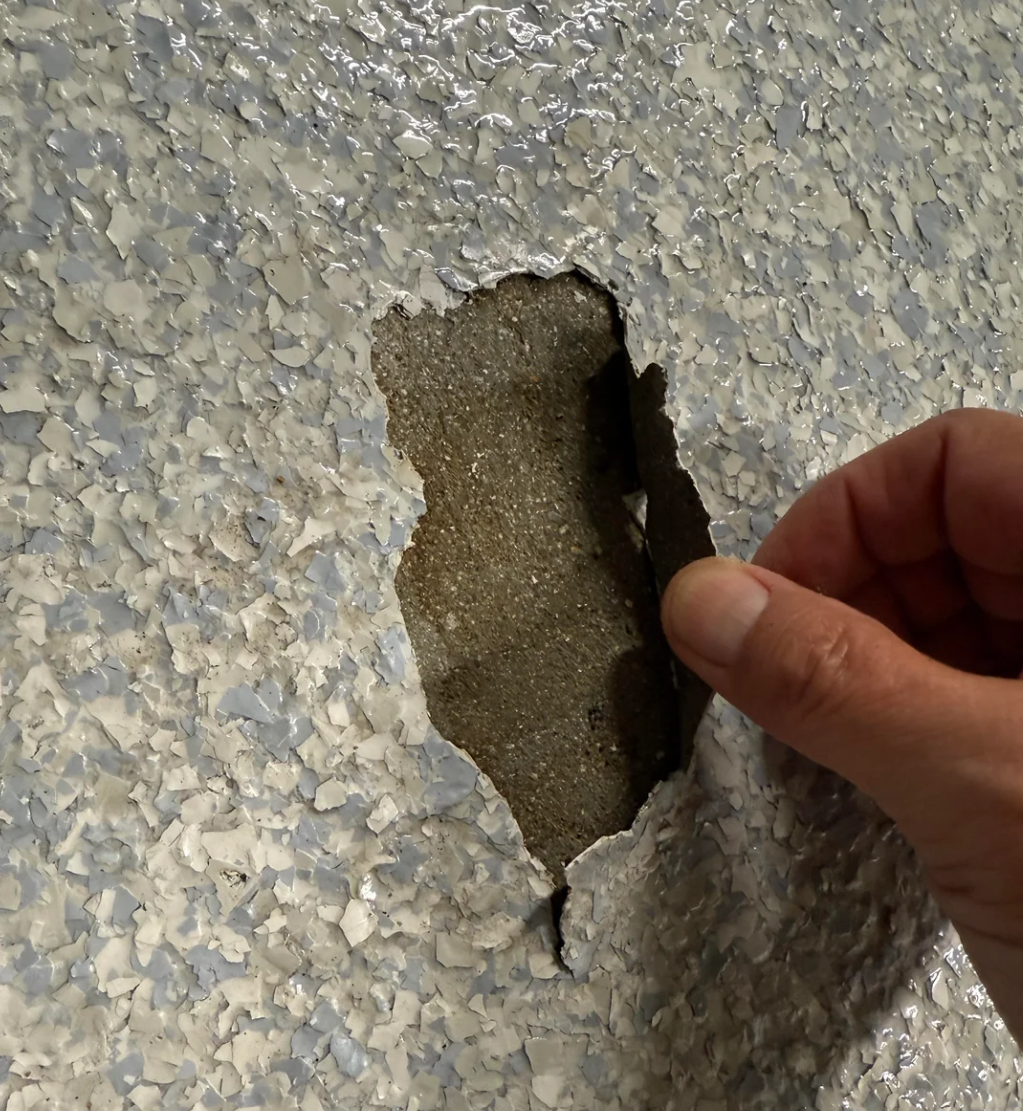
If you’ve searched for “why is my epoxy floor peeling” or “epoxy garage floor turning yellow,” there’s a good chance you’re in a hot climate — and there’s a good chance the floor was installed with a system that was never really built for it. Standard epoxy isn’t a bad product. It’s just often mismatched to conditions like Tucson’s, where garages regularly hit 120–130°F in direct summer sun and swing hard into monsoon humidity a few months later.
Here’s what actually happens to standard epoxy in that kind of climate, why it’s a bigger issue here than almost anywhere else in the country, and what a coating actually needs to hold up long-term in Arizona.
The Problem: What Heat and Sun Actually Do to Epoxy
There are three failure patterns that show up constantly in hot-climate garages, and they’re rarely caused by bad installation alone — they’re often caused by the wrong material for the conditions.
UV yellowing and chalking. Standard epoxy resin isn’t inherently UV-stable. Under prolonged sun exposure, it breaks down at a molecular level, causing the surface to yellow, fade, or develop a chalky residue. This is purely cosmetic at first, but it’s usually the first visible sign that the topcoat isn’t holding up to the conditions it’s in.
Hot-tire pickup. When a car sits in a hot garage after driving on sun-baked pavement, the tires themselves can reach very high temperatures. As the vehicle moves, the heat and slight tackiness in the tire rubber can pull at a coating that hasn’t fully cured or isn’t formulated to resist it — leaving marks, minor lifting, or in worse cases, small sections that peel up entirely.
Thermal expansion cracking. Concrete and coatings both expand and contract with temperature. Tucson’s daily swings — sometimes 30–40 degrees between a summer night and afternoon — put real stress on that bond over time. A coating without enough flexibility, or applied too thin, is more likely to crack along existing concrete joints or develop stress fractures where the two materials move at slightly different rates.
None of these are unusual or mysterious. They’re predictable outcomes of using a standard, non-UV-stable epoxy system in a climate that pushes it well outside the conditions it was designed for.
Why This Is a Tucson Problem, Not a Generic One
A lot of epoxy flooring content online is written for markets that simply don’t deal with this. A garage in Seattle or Minneapolis isn’t fighting 130°F surface temperatures or months of near-constant direct sun. The advice that works there doesn’t automatically transfer here, and a few things make Tucson specifically demanding on a coating:
- Sun exposure and orientation. South- and west-facing garage doors take direct sun for a large part of the day, especially in summer. Even a few hours of consistent direct light accelerates UV breakdown compared to a shaded or north-facing garage.
- Garage heat buildup. An enclosed garage with a closed door can trap heat well above the outdoor ambient temperature, especially in the afternoon. That heat load sits directly on the floor for hours at a time.
- Monsoon humidity swings. Tucson goes from bone-dry heat to sudden monsoon humidity and moisture for several weeks each summer. That swing stresses coatings that weren’t formulated to handle both extremes, and can also affect adhesion if the concrete wasn’t properly prepped for moisture in the first place.
Put together, a Tucson garage floor deals with more sustained thermal and UV stress in a single year than a lot of coatings ever get tested against.
What’s Actually Happening at the Material Level
Without getting too technical: epoxy resin, at a chemical level, is vulnerable to UV radiation breaking down its molecular structure over time — this is what causes the yellowing and chalking. Manufacturers address this in one of two ways: adding UV inhibitors to the epoxy formula itself, or applying a separate UV-stable topcoat (often polyaspartic or polyurethane) over the epoxy base to shield it from direct light exposure.
Standard, budget epoxy systems — including a lot of DIY kits — often skip this protection entirely, because it adds cost and isn’t necessary in milder climates. That’s a reasonable tradeoff in a lot of the country. In Tucson, it’s usually the single biggest reason a “why did my epoxy floor fail so fast” situation happens.
Thickness matters too. A properly applied system uses multiple coats to reach a specific mil thickness (a measure of coating thickness), which affects both durability and the coating’s ability to flex slightly with the concrete’s thermal movement instead of cracking. Thin, single-coat applications — common with cheaper installs — have less material to absorb that stress.
What Actually Holds Up in This Climate
he floors that hold up well in Tucson tend to share a few specific traits, regardless of exact brand or product line:
- UV-stable topcoats. Whether that’s a UV-inhibited epoxy formula or a polyaspartic/polyurethane topcoat layered over an epoxy base, some form of UV protection is close to non-negotiable for garages with real sun exposure. We cover this tradeoff in more detail in epoxy vs. polyaspartic garage floor coatings if you’re deciding between systems.
- Proper mil thickness. Multiple coats applied to spec, not a single thin layer, to give the floor enough material to handle thermal movement.
- Aggregate or flake broadcast where appropriate. Beyond the aesthetic benefit, textured systems can help distribute stress across the surface slightly better than a smooth, solid coat, and they hide minor wear better over time.
- Real surface prep. Diamond-ground concrete bonds far better than an acid-etched surface, and a strong mechanical bond is what keeps a coating from delaminating when the slab expands and contracts.
None of this is exotic — it’s a matter of specifying materials and installation methods for the actual conditions, rather than defaulting to whatever’s cheapest or most common nationally.
What This Looks Like in Practice
Two garages with the exact same square footage and the exact same visible finish on install day can age completely differently within two or three Tucson summers, depending entirely on whether these details were addressed. A garage with a UV-stable topcoat and proper prep still looks close to day one; a garage with a budget, non-UV-rated system often shows visible yellowing, some hot-tire marking near the most-used parking spot, and occasionally hairline cracking along the control joints — all within a couple of years, sometimes less.
If your existing floor is already showing these signs, it doesn’t necessarily mean a full teardown — depending on condition, a properly prepped recoat with the right materials can often fix it. Worth having it assessed rather than assuming the worst.
How Long Should a Properly Installed Floor Last Here?
With the right system and prep, a garage floor coating in Tucson should hold up for well over a decade, not just a couple of years. For a full breakdown of realistic lifespans by system type and what shortens them, see how long does an epoxy floor last in Tucson’s climate.
Get a Straight Answer for Your Garage
Every garage is a little different — sun exposure, orientation, and existing concrete condition all affect what system makes sense. If you want a real assessment rather than a guess, we offer free on-site evaluations and can tell you honestly what your floor needs, including whether a UV-stable topcoat is worth the added cost for your specific situation.
Frequently Asked Questions
Standard epoxy resin isn’t inherently UV-stable, and prolonged sun exposure breaks it down at a molecular level, causing yellowing or a chalky surface over time. This happens faster in climates with intense, sustained sun exposure like Tucson’s.
Yes — using a coating system formulated to resist hot-tire pickup (often a polyaspartic or polyurethane topcoat) and ensuring the coating is properly cured before regular vehicle use significantly reduces this issue.
UV-inhibited epoxy formulas exist, but the more common and typically more effective solution is pairing a standard epoxy base coat with a UV-stable polyaspartic or polyurethane topcoat, which shields the epoxy from direct UV exposure.
Garages with south- or west-facing doors, large windows, or that see direct sunlight for several hours a day are the most likely to need UV protection. A quick on-site assessment can confirm how much exposure your specific garage gets.
In a climate like Tucson’s, generally yes — the added upfront cost is usually far less than the cost of repairing or recoating a floor that fails early due to UV breakdown, hot-tire damage, or cracking.
Leave a Reply